Emotional Alchemy: Transform Feelings
Devin
1/31/202610 min read
The Transformation of Feeling into Wisdom
Something triggers you. A comment lands wrong. A memory surfaces. A moment of rejection. And suddenly you're flooded. Your chest tightens. Your face flushes. Your mind spirals. The familiar emotion has you.
For most of your life, this has been the pattern. Emotion arises and you're its prisoner. You react from it. You suppress it. You distract yourself from it. You manage it. But you're perpetually at its mercy.
What if there's a different way?
What if emotions aren't obstacles to overcome but raw material to transform? What if the very feelings you've been defending against contain within them the seeds of wisdom, clarity, and deepened aliveness?
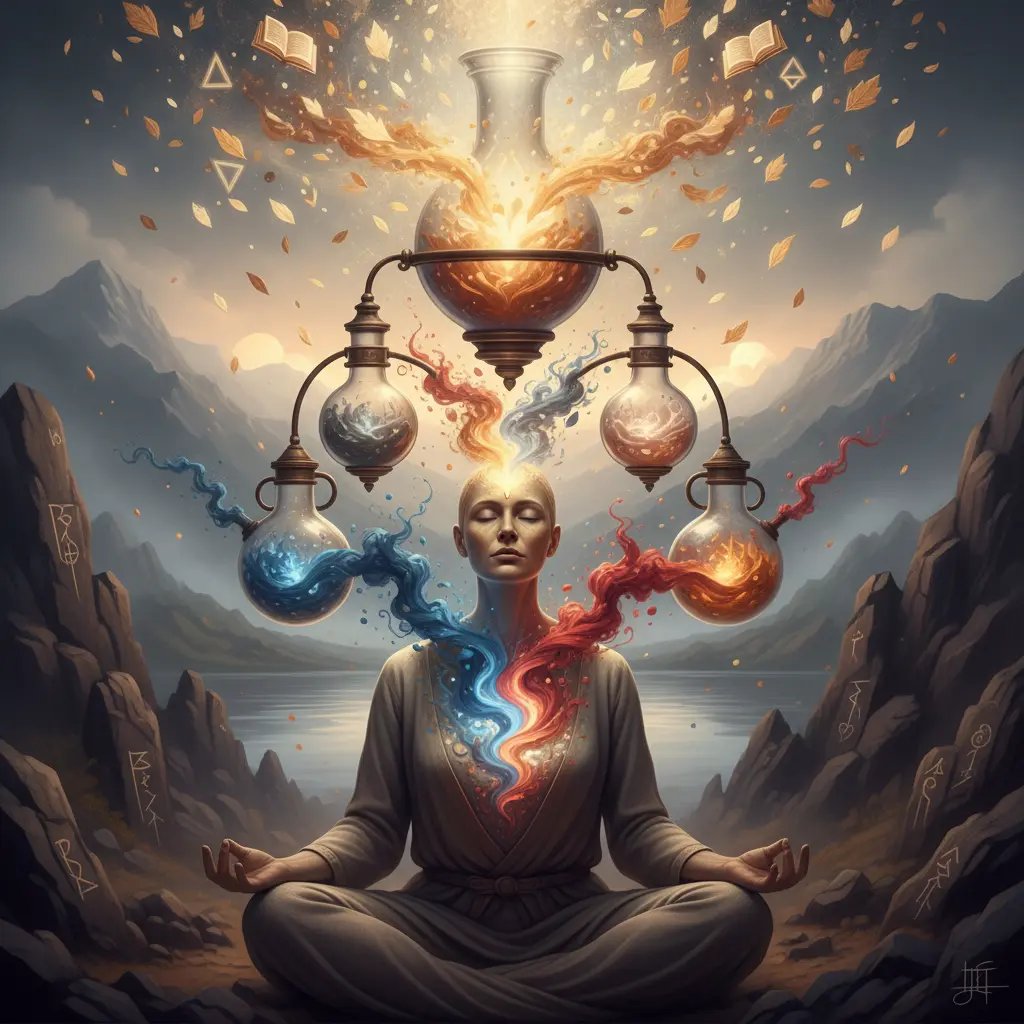
This is emotional alchemy. The capacity to move through emotion in such a way that its charge transforms into resource.
What is Emotional Alchemy?
Emotional alchemy is not transcendence. It's not rising above emotion or pretending it doesn't exist. It's also not indulgence, where you wallow in feeling without transformation.
Emotional alchemy is the capacity to feel an emotion fully while maintaining the perspective that you are not that emotion. To experience the physical and energetic reality of the feeling without being overtaken by its story. To allow the emotion to move through your system until its charge transforms into something usable.
Consider what happens physiologically when an emotion arises. Your nervous system activates. Neurotransmitters flood your body. Your physiology reorganizes. If you suppress this response or fight against it, the energy gets stuck. It stagnates. It becomes chronic tension, stored trauma, or emotional numbness.
If you indulge the emotion, reinforcing the story it carries, acting from it repeatedly, the pattern solidifies. You become trapped in reactivity.
Emotional alchemy is a third way. You acknowledge the emotion. You allow your body to fully experience its activation. You feel it completely. But simultaneously, you maintain the perspective of witness. You're experiencing this, but you're not identified with it. You're observing the emotion the way you'd observe weather passing through the sky.
Clouds gather. Rain falls. Lightning flashes. Wind blows. Then the storm passes. The sky doesn't become the storm. The sky witnesses the storm. And the sky remains unaffected.
When you adopt this stance toward emotion, full feeling combined with witnessing perspective, the charge transforms. What was raw reactivity becomes integrated resource. What was threatening becomes navigable. What was fragmenting becomes clarifying.
How Emotional Alchemy Manifests
The manifestations of emotional alchemy are transformative.
You feel deep sadness about a loss. Normally, this would send you into depression for days. With emotional alchemy, you feel the sadness completely. You allow your body to grieve. You cry. You acknowledge what's true. Something real is gone and that matters. But you don't reinforce the story that you're broken or abandoned. You feel the sadness moving through you, and as it moves, something shifts. The sadness transforms into compassion. Not just for your loss, but for the universal experience of loss that all beings face. Your grief becomes a door to a larger perspective.
You feel intense anger. Normally, this would drive you to lash out or internalize resentment. With emotional alchemy, you feel the anger fully. You acknowledge what it's signaling, that a boundary has been crossed or something matters deeply to you. You allow the physical activation, the heat, the energy of the anger. But you don't act from it blindly. You observe it. And as you do, the anger transforms into clarity. You understand precisely what you need to communicate or change. The anger becomes power. Not the power to harm, but the power to act decisively.
You feel acute anxiety. Normally, this would contract you, pull you into planning and protection. With emotional alchemy, you feel the anxiety. You notice where it lives in your body. You allow the activation. But you recognize that the threat it's responding to is often not present now. It's about an imagined future. You feel the anxiety and simultaneously remind yourself that right now, in this moment, you're actually safe. As you do this, the anxiety transmutes. It becomes alertness, a useful attunement to potential challenges without the paralyzing contraction.
You feel shame about something you've done. Normally, this would drive you to hide or to self-criticism. With emotional alchemy, you feel the shame completely. You acknowledge what it's signaling, that you acted in a way that's inconsistent with your values. But you don't identify with shame's narrative that you're fundamentally flawed. You feel it moving through you, acknowledging what it reveals. And it transforms into humility and recommitment to your values. The shame becomes catalyst for change.
The Neuroscience of Emotional Alchemy
The capacity for emotional alchemy corresponds to specific neurological changes.
In ordinary consciousness, when an emotion is activated, the amygdala (emotional center) and parts of the prefrontal cortex (executive function) are in a particular relationship. The emotion hijacks the system. The prefrontal cortex goes offline. You're essentially operating from the emotional brain alone.
With emotional alchemy, a different organization emerges. The prefrontal cortex remains online even as the emotion is activated. You're maintaining executive awareness while experiencing the emotion. This creates what researchers call "affect regulation", the capacity to feel emotion fully while still maintaining perspective.
The key neurological change is the development of stronger connections between the amygdala and the prefrontal cortex. People who practice emotional alchemy consistently show increased connectivity in this pathway. Over time, this rewires the brain. The baseline relationship between emotional and executive systems reorganizes.
The insula, the part of the brain associated with interoception (sensing internal states) and emotional awareness, also becomes more active and more connected with other brain regions. This creates more sophisticated emotional sensitivity combined with perspective.
What's remarkable is that with consistent practice, these brain changes become permanent. You don't only access emotional alchemy during meditation or in special circumstances. It becomes your baseline. Your brain has reorganized around this capacity.
Interestingly, people who develop emotional alchemy don't become emotionally flat. They feel more, not less. Their emotional sensitivity increases. But it's paired with the capacity to move through emotions rather than be trapped by them. They experience richer emotional life while being less controlled by it.
Why Emotional Alchemy Matters
The development of emotional alchemy capacity is liberating in profound ways.
First, it returns autonomy to you. In Homo sapiens consciousness, emotions are often experienced as things that happen to you, that control you. With emotional alchemy, emotions become information you're working with rather than forces controlling you. You have choice about how you relate to them.
Second, it transforms your capacity for authentic intimacy. So much of ordinary relating is about managing emotions, hiding what you feel, performing what you think others want to see, protecting yourself from emotional activation. With emotional alchemy, you can be genuinely present with your emotions. This allows genuine intimacy because you're not managing or hiding. You're authentically available.
Third, it radically improves your decision-making. Emotions carry important information. But when you're overtaken by them, that information gets buried in reactivity. With emotional alchemy, you access the information emotions carry while not being controlled by them. This makes you far more capable of wise decision-making.
Fourth, it dissolves chronic patterns. Many physical ailments and psychological patterns are rooted in emotions that have been suppressed or stuck. As you develop emotional alchemy, you're able to move these emotions through your system. They no longer need to manifest as chronic tension or disease.
Fifth, it opens you to genuine spiritual development. Many spiritual traditions teach the transcendence of emotion. But true development isn't escaping emotion, it's integrating it. As you develop emotional alchemy, you're not trying to leave emotion behind. You're becoming friends with it. This is the integration that actual spiritual development requires.
Most fundamentally, emotional alchemy is the recognition that nothing needs to be resisted. The emotion you've been defending against is actually medicine. It's trying to teach you something. It's trying to mature you. When you stop resisting and allow the transformation, everything changes.
Signs You're Developing Emotional Alchemy
Several signs indicate you're developing the capacity for emotional alchemy.
You recover more quickly from emotional activation. Something that would have had you upset for days now moves through you more quickly. The charge decreases rapidly.
Your emotional reactions become less automatic. You notice more space between stimulus and response. The emotion still arises, but you're not immediately captured by it. You can observe it arising.
You find yourself being curious about your emotions rather than ashamed of them. When an emotion surfaces, your first impulse is to understand what it's signaling rather than to suppress it or judge yourself for having it.
Your emotions become cleaner, less tangled with stories. Sadness is sadness. Anger is anger. They're not mixed with guilt or shame or judgment. The emotion is clear because you're not adding narrative to it.
You experience increased emotional depth and nuance. You feel grief and gratitude simultaneously. You feel anger and compassion toward the same person. Emotions are no longer one-dimensional.
You become less reactive in your communication. Where you would have defended or attacked, you now speak from a place of witnessing your emotion while communicating what's true.
People around you often remark that you seem different, calmer, more accepting. Your increased emotional alchemy creates a calming field that other people sense.
Developing Emotional Alchemy
The development of emotional alchemy requires specific practices and approaches.
The foundational practice is cultivating the witness perspective. In meditation, you practice observing your thoughts without identifying with them. You're training the capacity to observe. As this capacity develops in meditation, it naturally extends to emotions. You begin observing emotions the same way, noting their presence without being overtaken.
Specific emotion-focused practices accelerate the development. Breathwork practices are powerful. When you consciously work with your breath while experiencing an emotion, you create space. You're regulating your nervous system while also experiencing the emotion. This teaches your system that activation and stability can coexist.
Somatic practices like yoga, authentic movement, or dance work with emotions through the body. Since emotions live in the body, working with the body directly transforms emotions. As you move consciously, you're moving emotions through your system. They transform as they move.
Journaling specifically for emotional alchemy is powerful. You write not to analyze but to feel. You write what wants to come, allowing the emotion to move through your hand onto the page. As you do this, the charge begins to transform.
Voice work, singing, toning, or simply allowing sound to emerge with the emotion, is profoundly transformative. Sound moves emotion through your system more quickly than almost anything else.
Therapy or coaching can support emotional alchemy development if approached correctly. Working with someone who understands this capacity, you practice feeling emotions while maintaining perspective. Over time, you internalize the capacity.
Crucially, emotional alchemy development requires patience and self-compassion. You're retraining your nervous system. You're asking your body to do something it hasn't done before. Some days will be difficult. Some emotions will overwhelm your capacity to witness. That's okay. You're practicing, not perfecting.
Common Blocks to Emotional Alchemy
Several blocks commonly prevent emotional alchemy development.
The first is the belief that emotions should be controlled or transcended. You think the goal is to not feel emotion, to be emotionally stable in the sense of being flat. This directly contradicts emotional alchemy, which requires full feeling.
Understanding that emotional alchemy requires feeling, not transcendence, dissolves this block.
The second block is the fear of what will happen if you allow emotion to move through you. You're unconsciously terrified that if you feel the grief fully, it will never end. If you feel the anger, you'll hurt someone. If you feel the shame, you'll be destroyed.
In reality, emotions that are fully felt and witnessed move through relatively quickly. It's emotions that are suppressed that persist. Allowing the movement is what creates freedom.
The third block is shame about having emotions. You believe that mature, strong people don't feel deeply or get emotional. You judge your emotions as weakness.
Recognizing that emotional alchemy is sophisticated maturity, dissolves this block. It takes far more strength and wisdom to fully feel an emotion while maintaining perspective than it does to suppress or act from it.
The fourth block is excessive rationalization. You use your mind to manage emotions rather than feel them. You analyze why you feel that way rather than letting yourself feel.
Practices that emphasize feeling over thinking, breathwork, movement, sound, help bypass this intellectual defense.
Emotional Alchemy and the Homo Luminous Path
Emotional alchemy is foundational to Homo Luminous consciousness because so much of awakened capacity requires emotional maturity.
Authentic communication requires emotional alchemy. You can't speak truth while being controlled by emotion. But you can speak truth while fully feeling your emotion if you have emotional alchemy.
Compassion requires emotional alchemy. Genuine compassion isn't cold sympathy. It's feeling with someone while maintaining your own centeredness. That balance is emotional alchemy.
Non-reactive responsiveness requires emotional alchemy. You can't respond wisely if you're controlled by automatic emotional reactions. But if you can feel the emotion while maintaining witnessing perspective, you can respond from wisdom.
Coherence between being and doing requires emotional alchemy. You can't align your actions with your values if emotional suppression is driving your behavior. But as you develop emotional alchemy, you can act from authentic emotion rather than from defensive reactivity.
Emotional alchemy is the capacity that allows all the other Homo Luminous capacities to integrate into genuine maturity. Without it, awakening remains ungrounded. With it, awakening becomes embodied, real, and transformative.
The Transformation Available
What becomes possible as you develop emotional alchemy is a fundamental shift in how you relate to being alive.
You stop being afraid of your own inner world. You stop needing to manage or control emotions. You stop judging yourself for feeling. Instead, you become intimate with your own emotional landscape. You learn its language. You trust its wisdom.
You become capable of genuine empathy because you're not defended against others' emotions. You can feel with people without being overwhelmed or controlling the feeling.
You become capable of genuine joy because you're not defended against it. You can experience delight, connection, beauty without fear.
You become capable of being truly alive. Not in the sense of constant happiness, but in the sense of full presence with whatever's happening. Sadness, joy, anger, peace. You can meet it all with openness.
This is the transformation available through emotional alchemy. Not the transcendence of emotion. The full embrace of it as the rich, intelligent, deeply human part of your being that it is.
Next Steps
If emotional alchemy resonates with you, the invitation is to begin exploring your relationship with emotion.
Notice one emotion that regularly arises for you, perhaps anxiety or sadness or anger. The next time you feel it, try something different. Rather than immediately acting on it or suppressing it, stop for a moment. Take several deep breaths. Feel where the emotion lives in your body. Breathe into that place. Don't try to change the emotion. Just feel it fully while maintaining awareness that you're feeling it. You're the one experiencing this, but you're not it.
Do this for several breaths. Notice what happens.
This simple practice is the beginning of emotional alchemy. You're starting to create space between yourself and your emotions. You're beginning to develop the witness perspective.
Over time, as you practice this repeatedly, your entire relationship with emotion will shift. What was terrifying becomes navigable. What was controlling becomes informative. What was fragmenting becomes integrating.
You're developing emotional alchemy. And emotional alchemy is awakening to the wisdom that lives within your feeling nature.
Next:
Emotional Alchemy