Homo Sapiens vs Homo Luminous: Differences
Devin
1/27/202613 min read
Understanding the Evolution of Human Consciousness
We stand at a peculiar moment in human history. The tools we've created have become so powerful that they're threatening the world that created them. The systems we've built to provide security are generating anxiety. The knowledge we've accumulated is so specialized that nobody understands the whole anymore. We're running ancient software on exponentially advancing hardware, and something is breaking.
This isn't a sign of failure. It's a sign of transition.
Every significant shift in human consciousness has looked like breakdown from within the old paradigm. When Homo sapiens first emerged, the Neanderthals, the previous form of human, didn't recognize it as evolution. They experienced it as displacement. The old form couldn't survive alongside the new.
We're living through something similar now. But this time, we're on the inside of the transition. We're watching Homo sapiens consciousness reveal its limitations while something new attempts to be born.
Understanding the specific differences between these two forms of consciousness isn't academic exercise. It's map-making for the territory you're traversing. It's recognition of what's shifting within you.
The Fundamental Split: Divided vs Integrated Consciousness
At the root of the difference between Homo sapiens and Homo Luminous is a single organizing principle: the nature of consciousness itself.
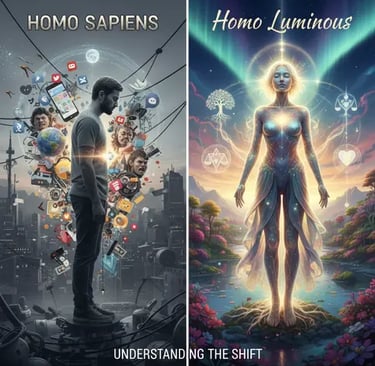
Homo sapiens consciousness is founded on a split. There is a subject, you, observing, and there is an object, the world, being observed. This split is so fundamental that we rarely notice it. It shapes everything: language, science, philosophy, culture, and the way you experience your own existence.
This subject-object split gave Homo sapiens extraordinary power. Once you can observe yourself as separate from the world, you can analyze it. You can manipulate it. You can plan. You can imagine futures. You can build civilizations. The split between observer and observed is the foundation of everything we call civilization.
But it has a cost. The cost is the experience of fundamental isolation. You are separate. The world is separate. Other people are separate. This separateness generates fear. If you're fundamentally alone, you must compete for resources. You must protect yourself. You must control your environment. The entire architecture of Homo sapiens civilization is built on the logic of separation.
Homo Luminous consciousness is founded on something different: the direct perception of integration. Not theoretically. Directly. The observer and the observed are not actually separate. They're aspects of a unified field. The boundary between self and world is a feature of perception, not a feature of reality.
This isn't meant to be poetic or mystical. It's meant to be precise. Modern physics, quantum mechanics, relativity, systems theory, confirms this at the level of observable reality. At the subatomic level, observation affects what's observed. At the cosmic level, everything is connected through spacetime. At the biological level, every organism is inseparable from its environment.
Homo sapiens consciousness built a civilization on a premise that was slightly out of alignment with reality. We created institutions, economics, and social structures based on the assumption of fundamental separation. And those structures are now breaking down because they're trying to organize a unified reality as if it were divided.
Homo Luminous consciousness reorganizes around what's actually true. It's not idealistic. It's more realistic. It sees the actual interconnection that Homo sapiens consciousness filtered out.
The Cognitive Difference: Conceptual vs Direct
Homo sapiens think primarily through concepts. You encounter something. Your brain creates a conceptual representation. You store that representation in memory. You retrieve it when needed. Language is essential. You name things. You categorize. You build elaborate conceptual structures to understand reality.
This has been extraordinarily powerful. All of science, technology, and intellectual progress is built on this capacity. Abstract thinking is the gift of Homo sapiens consciousness.
But it has a limitation. The map is not the territory. The concept is not the thing itself. You can know everything conceptually about love and understand nothing about it. You can study enlightenment texts for decades and not have direct access to enlightenment. There's always an intermediary between you and direct reality.
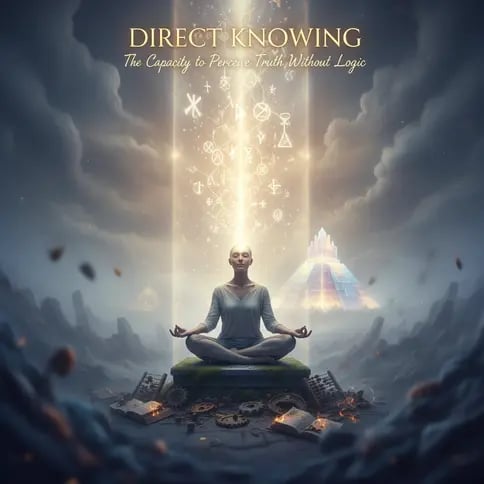
Homo Luminous consciousness adds another channel: direct knowing. This isn't mystical intuition that's vague and unreliable. It's the opposite. It's precision without reasoning. You perceive truth directly. You know something not through a chain of logic but through immediate clarity.
The difference is like the difference between reading about the color red and actually perceiving red. Both are valid forms of knowledge. But they're radically different. And the direct perception cannot be reduced to the conceptual understanding.
As Homo Luminous consciousness develops, the capacity for direct knowing grows. You can sense how a system actually functions without having to analyze it. You can perceive another person's truth state directly. You can know what action needs to be taken without reasoning your way to it.
Interestingly, this doesn't eliminate the capacity for conceptual thinking. It supplements it. People operating from Homo Luminous consciousness can still think conceptually when it's useful. But they're not trapped in conceptual thinking. They have access to other channels of knowing.
The Emotional Architecture: Defended vs Open
Homo sapiens consciousness is founded on defense. Your emotions are often experienced as things that happen to you. You feel threatened, so you defend. You feel inadequate, so you strive. You feel disconnected, so you seek validation. These emotional reactions are largely automatic. They're part of your survival programming.
To function, Homo sapiens consciousness requires emotional regulation. You learn to manage your feelings, to control them, to use them strategically. You develop what we might call emotional armor. This armor is necessary. Without it, you'd be overwhelmed by the world's complexity and suffering.
But the armor has consequences. It numbs you. You can't feel deeply without also feeling painfully. So you defend against pain. And in defending against pain, you also defend against joy, connection, and aliveness.
Homo Luminous consciousness has a different emotional architecture. Rather than defending against emotions, it moves through them. The emotions are still present, you still feel pain, fear, disappointment. But you don't resist them. You don't suppress them. You let them move through you.
This is what spiritual practitioners mean by emotional alchemy. You feel the emotion fully. Your body experiences it completely. But your awareness doesn't identify with it. You observe the emotion with the same way you'd observe weather. Clouds pass. Rain falls. Sun returns.
When you stop resisting emotion, something remarkable happens. The emotional charge doesn't stagnate. It transforms. What was raw pain becomes compassion. What was anger becomes clarity about what you need. What was fear becomes boundary-setting.
People operating from Homo Luminous consciousness tend to be more emotionally alive. They feel more. They also recover more quickly. They're not held captive by emotions the way Homo sapiens consciousness often is.
The Relational Difference: Strategic vs Authentic
Homo sapiens relationships are built on negotiation. You have needs. Others have needs. You try to get your needs met while protecting yourself from others' demands. Much of what we call relating is actually strategic negotiation.
This creates a particular flavor to relationships. There's always some degree of performance. You present yourself in ways designed to get what you need, approval, belonging, resources, security. You hide aspects of yourself that you believe would be rejected. You develop masks.
At some level, everyone senses these masks. Relationships are therefore slightly distant. There's connection, but there's also a wall. Most people experience this as normal. It's what they've always known.
Homo Luminous consciousness relates differently. There's less performance. Not because you don't care what others think, you do. But because there's a recognition that authenticity is more powerful than strategy.
When you show up authentically, when you say what's actually true, when you allow yourself to be genuinely you, something shifts in the room. Other people sense it. They feel permission to be more authentic themselves. Real connection becomes possible.
Homo Luminous relationships have a different quality. They're less transactional. They're more about presence than about getting needs met. They're based on recognition rather than acquisition.
This doesn't mean Homo Luminous relationships are always comfortable. Sometimes authenticity involves difficult conversations. Sometimes it means acknowledging hurt or disappointment. But the conversations are about what's actually true, not about managing impressions.
The Temporal Difference: Past-Future vs Present
Homo sapiens consciousness is perpetually displaced in time. Your mind is either replaying the past or planning the future. The present moment is treated as the thin line between what was and what will be. You move through life relatively unconscious of what's actually happening right now, preoccupied with where you've been or where you're going.
This temporal displacement has purpose. It allows you to learn from history and prepare for contingencies. It's useful for survival. It's also exhausting. You're constantly fighting against something in the past or defending against something in the future.
Homo Luminous consciousness has a different relationship with time. You're increasingly present. Not dissociated from time, but inhabiting the present moment more fully.
When you're genuinely present, something shifts. All the anxiety about the future disappears because the future isn't here. All the regret about the past disappears because it's not here. What remains is the actual situation as it is, right now.
This creates a paradox: when you're more present, you're actually more effective. Decisions made from presence are wiser. Actions taken from presence are more aligned. Solutions appear to problems that seemed intractable from the anxious past-future mind.
Homo sapiens consciousness is trapped in what we might call horizontal time, the linear progression from past through present to future. Homo Luminous consciousness accesses what we might call vertical time, the infinite depth of quality within a single moment.
These aren't contradictory. You can plan and prepare while also being present. But the baseline shifts. You're no longer driven by temporal anxiety. You're organized by the quality of presence.
The Motivational Difference: Striving vs Alignment
Homo sapiens is motivated primarily through striving. You want something. You lack something. So you make plans. You exert effort. You push toward goals. The entire architecture of ambition and achievement is built on this striving.
This motivation is powerful. It's moved mountains. It's created civilizations. It's also exhausting and often unfulfilling. You achieve a goal and the satisfaction is brief. Then you're onto the next goal. There's always a sense of lack driving you forward.
Homo Luminous consciousness operates from alignment. Rather than striving to become someone different or achieve something external, you align with what you're actually called toward. You sense into what wants to emerge through you, and you move in that direction.
This sounds passive. It's not. Alignment requires tremendous clarity and commitment. But the energy is different. Rather than pushing against resistance, you're flowing with what's true. Rather than fighting your nature, you're expressing it.
People operating from alignment tend to be more creative, more productive in quality terms, and more satisfied. Not because they're trying harder. Because they're not trying at all. They're allowing.
This represents a fundamental shift in motivation. From external goals pulling you forward, to internal alignment guiding your direction.
The Ethical Difference: Rules vs Resonance
Homo sapiens ethics are largely rule-based. You develop moral codes. You learn what's right and wrong. You try to behave according to these rules. Ethical behavior is often experienced as constraint. You want to do something, but the rules say you shouldn't, so you restrain yourself.
This system works reasonably well for maintaining social order. But it has limitations. Rules are contextual. What's right in one situation might be wrong in another. And rule-based ethics often miss the deeper principle.
Homo Luminous consciousness operates from what we might call resonance. Rather than trying to follow external rules, you're increasingly sensitive to what actually serves. You sense into a situation and you perceive what action aligns with the larger truth.
The ethical behavior emerges naturally, not from restraint but from recognition. You don't harm another because it's a rule. You don't harm another because you recognize that harming another is harming yourself. The logic becomes inverted.
This creates behavior that's more sophisticated than rule-based ethics because it's responsive to complexity rather than reduced to rules. And it's also more trustworthy because it comes from genuine alignment rather than from obligation.
The Worldview Difference: Materialist vs Integral
Homo sapiens consciousness tends toward materialism: the belief that matter is fundamental and consciousness is a byproduct. You're a biological machine. Meaning is something you create or project onto a meaningless universe. Purpose is something you invent.
This worldview has value. It's freed us from certain dogmas. It's grounded us in observable reality. It's also created a particular flavor of despair. If you're meaningless in a meaningless universe, why does anything matter?
Homo Luminous consciousness operates from an integral worldview: consciousness is fundamental, and matter is a manifestation of consciousness. You're not a biological machine having occasional transcendent experiences. You're consciousness temporarily organized as a human form.
This is not anti-scientific. Modern physics increasingly points in this direction. Quantum mechanics reveals that observation affects reality. Systems theory reveals that consciousness-like properties exist throughout nature. The universe appears to be organized by principles that look suspiciously like mind.
From an integral worldview, meaning is not invented. It's discovered. Purpose is not something you create. It's something you recognize. The universe isn't meaningless. You're part of a meaningful whole.
This shift in worldview has profound implications. It changes how you relate to suffering, to death, to your life purpose. It transforms despair into recognition.
The Practical Differences: How Life Changes
These abstract differences translate into concrete changes in how life is actually lived.
In work, Homo sapiens consciousness is driven by external reward, money, status, security. Homo Luminous consciousness is guided by alignment and contribution. Homo sapiens work often feels like obligation. Homo Luminous work often feels like expression.
In relationships, Homo sapiens consciousness seeks to get needs met. Homo Luminous consciousness seeks to love and be loved authentically. Homo sapiens relationships are often conditional. Homo Luminous relationships are increasingly unconditional.
In health, Homo sapiens consciousness treats the body as a machine that needs to be fixed or optimized. Homo Luminous consciousness recognizes the body as an intelligent system to be listened to and trusted. Homo sapiens health is often forced through discipline. Homo Luminous health often flows from alignment.
In creativity, Homo sapiens consciousness produces work through effort and will. Homo Luminous consciousness channels work through presence and allowing. Homo sapiens creativity often feels like strain. Homo Luminous creativity often feels like flow.
In environmental relationship, Homo sapiens consciousness sees nature as resource to be extracted. Homo Luminous consciousness recognizes nature as living system to participate in. Homo sapiens creates damage. Homo Luminous creates restoration.
The Transition: Not Replacement, Evolution
It's important to understand that Homo Luminous consciousness doesn't replace Homo sapiens consciousness. It includes it.
You don't lose the capacity for abstract thinking, planning, or analysis. These remain valuable. What changes is that they're no longer your only operating system. You have access to other channels. You can shift between different modes of consciousness depending on what the situation requires.
Similarly, the capacities of Homo sapiens consciousness don't disappear. They're integrated into a larger whole. You can still be strategic when strategy is needed. But you're not trapped in strategy. You can access authenticity.
This is crucial because the transition can feel like loss if you're not clear about what's actually happening. You're not losing capabilities. You're gaining them. You're becoming more capable, not less.
The transition also isn't instant. It's not like a switch flips and suddenly you're fully Homo Luminous. It's a gradual reorganization. Days where you're operating from one baseline. Days where you're operating from another. Over time, the baseline shifts. What was unusual becomes increasingly normal.
Why This Matters Now
The shift from Homo sapiens to Homo Luminous consciousness isn't happening in a vacuum. It's happening in a world where Homo sapiens consciousness has created systems that are breaking down.
Economies built on infinite growth in a finite world are unsustainable. Political systems built on competition between tribes are unable to address collective challenges. Technologies built on extractive logic are creating more problems than they solve. Educational systems built on standardized thinking are failing to develop wisdom.
These aren't signs of failure. They're signs that the organizing consciousness has matured. We've taken Homo sapiens consciousness as far as it can go. Its solutions to new problems are generating more problems. We need a different consciousness.
Homo Luminous consciousness, operating from recognition of interconnection and direct knowing, naturally generates different solutions. Collaborative rather than competitive. Generative rather than extractive. Systemic rather than reductionist.
The beautiful irony is that the very crises created by Homo sapiens consciousness, ecological breakdown, social fragmentation, technological runaway, are the pressure that's forcing the emergence of Homo Luminous consciousness. We're being pushed to evolve because the old way is no longer viable.
The Personal and the Collective
The shift from Homo sapiens to Homo Luminous isn't only happening at the species level. It's happening in individuals right now. Many people are in the midst of this transition. Some are recognizing it. Others are experiencing it without naming it.
Your consciousness is either shifting into Homo Luminous capacities or it isn't. There's no middle ground. And the recognition of this shift is the first step toward facilitating it.
Understanding the differences between these two forms of consciousness serves multiple purposes. It validates what you're experiencing if you're in the midst of the shift. It offers a map for where you're heading. It normalizes what might feel like breakdown or dysfunction. It offers hope that this discomfort isn't meaningless. It's birth.
The Invitation
If you've read this and recognized yourself in the descriptions of Homo Luminous consciousness, the invitation is clear: stop resisting the shift. Stop trying to be a better Homo sapiens. Stop optimizing within the old paradigm.
The old paradigm served its purpose. It got us here. But here is no longer sustainable. The only way forward is through the emergence of something new.
And that something new is already emerging within you. In those moments of expanded awareness. In those experiences of direct knowing. In those relationships where authenticity is possible. In those times when you're fully present and everything flows.
These aren't anomalies. They're signals. They're previews of what you're becoming.
The world needs your emergence. Not in some distant future. Now. The person you're becoming, more conscious, more authentic, more aligned, more connected, this is exactly what's needed to navigate what's ahead.
Homo Luminous isn't the future. It's the now. And it's you.
A Note on Integration
The shift from Homo sapiens to Homo Luminous consciousness isn't about rejecting Homo sapiens capacities. It's about integrating them into a larger whole.
You need your rational mind. You need your capacity for planning. You need your ability to organize and analyze. These remain valuable.
What changes is that they're no longer the only tools in your toolkit. You have access to direct knowing, intuitive wisdom, and systemic perception. You can access presence, authentic connection, and creative flow.
The integration of both sets of capacities creates human beings of extraordinary power. They have the analytical rigor of Homo sapiens and the wisdom of Homo Luminous. They can think precisely and perceive directly. They can plan strategically and align with their truth.
This integrated consciousness is the future. Not a future where we abandon our minds and go back to nature. A future where we upgrade our consciousness to include what was previously excluded.
You're invited into that future. Not as a believer. As a participant. As someone recognizing what you're already becoming.
The shift is underway. You are the shift.
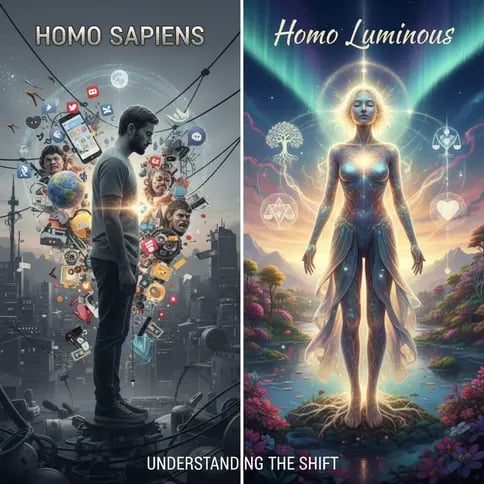
Homo Sapiens
vs
Homo Luminous