Present-Time Awareness: Power of Being Here
Devin
2/10/20269 min read
Present-Time Awareness
The Power of Being Here Now
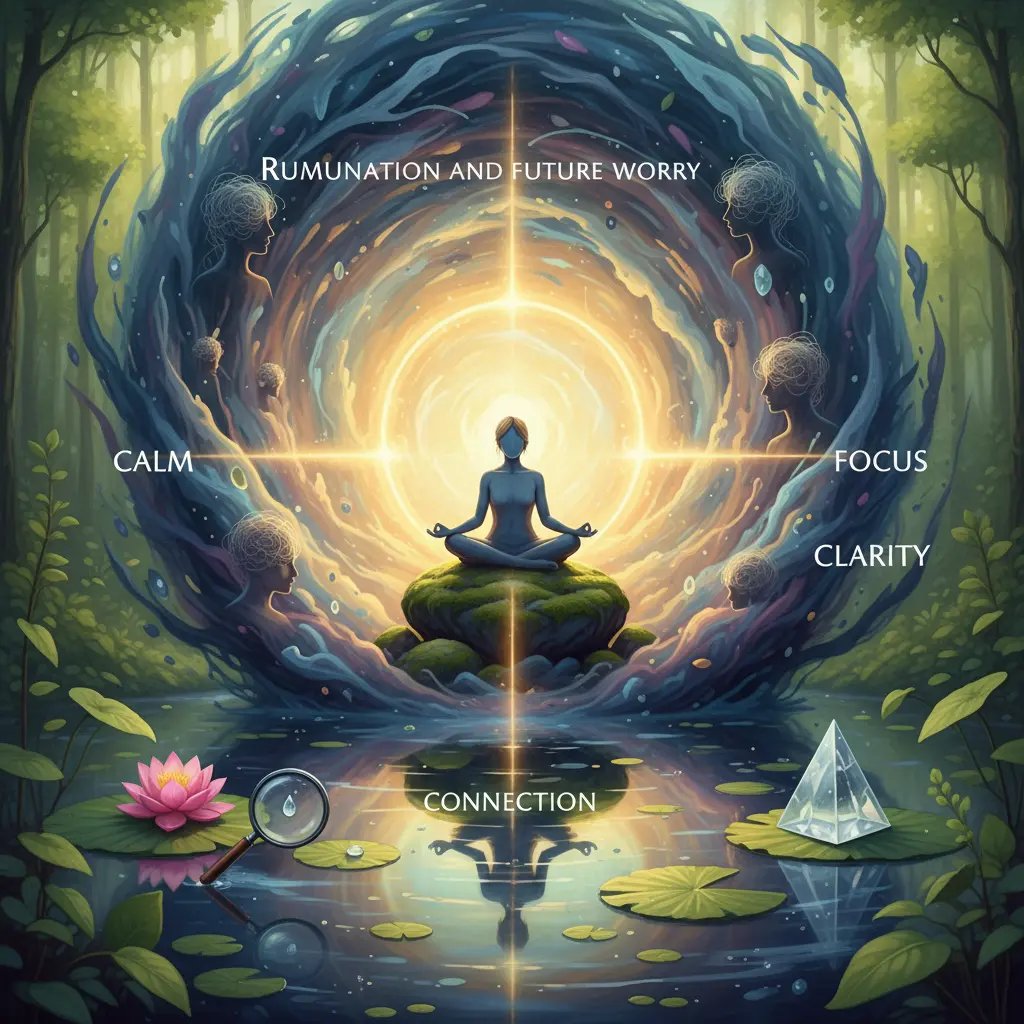
Your mind is not here. It's either replaying something that happened.
A conversation that went wrong, a choice you regret, a moment of embarrassment. Or it's rehearsing something that might happen. A meeting you're worried about, a conversation you're anxious about, a future you're trying to control.
The present moment (the only place where life happens) is barely visited. You move through the world on autopilot, your attention scattered across past and future.
Meanwhile, the people in front of you are trying to connect, but you're not really there. The meal you're eating could be the most delicious you've ever had, but you're tasting it through the filter of distraction. The work you're doing could be meaningful, but you're moving through it without real engagement.
This is the default state of Homo sapiens consciousness. Perpetually displaced in time.
What if you could be here? What if you could inhabit the present moment more fully? Not occasionally, in special moments, but as an increasing baseline?
This is present-time awareness. The capacity to be here, now, fully.
What is Present-Time Awareness?
Present-time awareness is the capacity to be genuinely located in the present moment. Not dissociated from time, but inhabiting this moment completely. Your full attention is here. Your awareness is here. You're not divided between past, present, and future.
In Homo sapiens consciousness, the mind is trained to be on time. You spend enormous attention on the past. Learning from it, regretting it, replaying it. You spend enormous attention on the future. Planning it, worrying about it, trying to control it. The present moment is treated as a thin line between these two temporal zones.
This temporal orientation has survival value. Learning from the past helps you avoid mistakes. Planning for the future helps you prepare for contingencies. But it has a cost. You're never fully here. And the only place where life happens is here. The present moment is the only place where anything real occurs. The past is memory. The future is imagination. Only now is real.
Present-time awareness is the gradual shift from this fragmented temporal orientation to increasingly inhabiting the present. Not through dissociation or denial of past and future. But by recognizing that the present moment contains far more than you typically perceive if you're fully here.
When you're genuinely present, anxiety about the future diminishes because the future isn't here. Regret about the past diminishes because it's not here. What remains is the actual situation as it is right now.
And here's the paradox: when you're more present, you're more effective. Decisions made from presence are wiser. Actions taken from presence are more aligned. You respond to what's happening rather than to your projections.
How Present-Time Awareness Manifests
The manifestations of present-time awareness are transformative.
You're in a conversation and you're fully here. You're not thinking about what you're going to say next or formulating responses. You're listening deeply. You're present with what the other person is expressing. This depth of attention creates connection that ordinary conversation never achieves.
You're doing a simple task and you're fully engaged. Washing dishes becomes interesting because you're experiencing it rather than doing it on autopilot. Walking becomes a rich experience because you're present to what you're perceiving rather than lost in thought.
You're experiencing discomfort, physical pain or emotional difficulty. Normally, you'd be trying to escape it or fighting against it. With present-time awareness, you're present with it. You're not identified with it. You're observing it. And something shifts. The resistance lessens. Often the discomfort itself becomes less intense.
You're deciding and you're not anxious about it. You're present to the actual situation. You perceive what's true. The decision becomes clear because you're not filtered through temporal anxiety.
You're with a loved one and you're fully there. Not partially present while checking your phone or planning what you'll do next. Fully present. The intimacy of that presence creates moments of genuine connection that people remember.
Your days have a different quality. They're less exhausting because you're not fighting time. You're less anxious because you're not preoccupied. Events have texture and depth because you're experiencing them.
The Neuroscience of Present-Time Awareness
The brain reorganizes significantly around present-time awareness.
In fragmented temporal consciousness, your default mode network (the system responsible for self-referential thinking) is highly active. You're constantly generating narratives about what things mean, what might happen, what you should do. You're scattered across past and future.
When you practice present-time awareness, something shifts. Brain scans of people in deep presence show different patterns. The default mode network quiets somewhat. Areas associated with present-moment attention activate. There's greater integration between different brain regions. The fragmented quality of ordinary consciousness gives way to more unified awareness.
The prefrontal cortex (the region involved in executive function and planning) doesn't go offline. You can still plan and think about the future when needed. But it's no longer your default mode.
Notably, the amygdala, the emotional center, becomes less reactive. When you're fully present, threat responses decrease. Your nervous system relaxes. This is one reason present-time awareness is so powerful for anxiety and stress.
With consistent practice in present-time awareness, these brain changes become permanent. People who meditate regularly show these changes becoming stable. Their baseline brain organization shifts toward greater presence.
This means that what starts as something you have to practice, intentionally bringing attention to the present, eventually becomes your baseline. You're naturally more present. Presence becomes easier than distraction.
Why Present-Time Awareness Matters
The development of present-time awareness capacity is fundamental to living a full life.
Firstly, it's revolutionary for your experience of wellbeing. Most anxiety comes from dwelling in an imagined future. Most depression comes from dwelling in the past. When you're truly present, these states don't arise as readily. You're not feeding them with repeated rumination.
Secondly, it's revolutionary for your relationships. The quality of presence you bring to someone is the quality of intimacy they feel. When you're fully present, people feel genuinely seen and heard. Real connection becomes possible.
Third, it's revolutionary for your effectiveness. Work done from presence is better. Decisions made from presence are wiser. Creativity flows more freely. You're responding to what's happening rather than to your projections.
Fourth, it's revolutionary for your perception of time itself. When you're fully present, a moment contains more quality, more depth, and more richness. Time feels abundant rather than scarce. Your life feels longer because you're living it more fully.
Fifth, it's revolutionary for your spiritual development. Many spiritual traditions recognize that enlightenment is essentially the permanent shift into present-time awareness. The deeper you can rest in the present moment, the more access you have to deeper dimensions of consciousness.
Most fundamentally, present-time awareness is the recognition that the present moment is everything. It's all there ever is. Past and future are constructs of mind. Only now is real. Learning to inhabit what's real is the beginning of living authentically.
Signs You're Developing Present-Time Awareness
Several signs indicate you're developing this capacity.
You notice more. Details that would have been invisible become visible. Colors are brighter. Sounds are clearer. You perceive more because you're paying attention.
Your anxiety decreases notably. You're not spending as much time in an imagined future, so anxiety has fewer hooks.
Your relationships deepen. People feel your presence. They're moved by your attention.
You experience more flow states. When you're present, you naturally enter flow. Deep engagement where time disappears and work becomes effortless.
Your daily life has more texture and richness. Ordinary activities become interesting because you're experiencing them fully.
You respond more than you react. You're not operating from automatic patterns as much because you're present to what's happening.
You feel less rushed. Even when you're busy, you're not stressed by time because you're present to what you're doing rather than worrying about what comes next.
Developing Present-Time Awareness
The development of present-time awareness requires consistent practice.
Meditation is the foundational practice. Sitting quietly and practicing bringing your attention back to the present moment, back to your breath, your sensations, awareness itself, trains your mind in presence. This is the fundamental practice. Do it regularly.
Beyond formal meditation, you can practice presence throughout your day. Notice your breath while doing ordinary activities. Feel your feet while walking. Taste your food while eating. Hear sounds while listening. You're training your attention to be here.
Mindful movement, yoga, conscious exercise, tai chi. Integrates present-time awareness into your body. You're training your nervous system to be present.
Single-tasking supports presence. When you're doing one thing fully rather than multitasking, presence is easier. You're not trying to be in multiple places simultaneously.
Creating periods of technology-free time supports presence. Devices fragment attention. Regular periods without them allow your attention to consolidate.
Nature supports presence naturally. Being in natural settings, your thinking mind naturally quiets. Presence becomes easier.
The practice of body awareness (noticing sensations, where you're holding tension, how your body feels) anchors awareness in the present. The body is always in the present. When you're aware of the body, you're in the present.
Common Blocks to Present-Time Awareness
Several blocks commonly prevent present-time awareness development.
The first is the belief that you have to be planning or worrying to be responsible. You believe that anxiety and planning are necessary to stay on top of things.
In reality, presence creates better planning and more effective action. You don't need the anxiety.
The second block is fear of what you'll experience if you're fully present. If you stop the constant mental activity, what will be there? For many people, the answer is: a lot of suppressed emotion or difficult feelings. There's fear of what will surface.
This fear dissolves as you practice. You discover that feelings that arise can be worked with. They're not as dangerous as you feared.
The third block is not actually creating the space for presence. Your life is so full that you never have quiet. You never have moments where presence is possible.
Creating regular periods of quiet and stillness is necessary. This might mean waking earlier, creating space in your evening, or other practices. But the space needs to be there.
The fourth block is getting frustrated with meditation or practice. You sit and your mind wanders a hundred times. You think you're bad at meditation. You give up.
Actually, recognizing that your mind has wandered and bringing it back is the practice. It's not something you do wrong. It is the whole point in the 1st place. It's the actual practice. You're strengthening the pathway every time you bring your attention back. The more you bring your attention back the better, so having too many thoughts is not a bad thing, it renders more opportunities for you to notice, and bring your attention back to breath.
Present-Time Awareness and the Homo Luminous Path
Present-time awareness is foundational to all the other Homo Luminous capacities.
Direct knowing is more accessible from presence. Emotional alchemy requires presence with the emotion. Authentic communication requires presence with what's actually true. Systemic perception requires presence to what's happening.
Present-time awareness is also the ground of spiritual awakening. Many spiritual traditions emphasize that enlightenment is the permanent shift into present-time awareness. It's not a special experience you have occasionally. It's the stable recognition that you are always, only here. Now.
People developing Homo Luminous consciousness naturally develop present-time awareness because as your consciousness expands, temporal fragmentation becomes increasingly untenable. You perceive that past and future are constructs. You're drawn toward residing in what's real:
The present moment.
The Life Available
What becomes possible as you develop present-time awareness is a life that's lived.
You're not perpetually preoccupied with past regrets or future anxieties. You're here. You're experiencing this moment.
You're connecting. You're creating. You're working. You're loving.
Your anxiety decreases because you're not manufacturing threats in an imagined future. Your depression decreases because you're not obsessing about the past. You're naturally more at peace because you're not at war with time.
And life takes on a richness it didn't have before. Because you're experiencing it fully. Because you're present to it. Because you're living it rather than moving through it on autopilot.
This is the life available. The life of presence. The life of being here, now, fully.
That life is available to you right now. This present moment is all you ever need to be present to.
Next
Stop reading. Close your eyes. Take three slow breaths. Notice your breath. Feel your body. Listen to sounds around you.
For just thirty seconds, be present. That's it.
When you're ready, open your eyes. Notice the quality of that moment.
That's the beginning of present-time awareness. That's the practice.
Do this multiple times throughout your day. Thirty seconds of presence. Multiple times daily.
Over time, presence becomes easier. Your baseline shifts. You spend more time here. In this moment. Where life happens.
You're developing present-time awareness. It is the foundation of Homo Luminous consciousness.